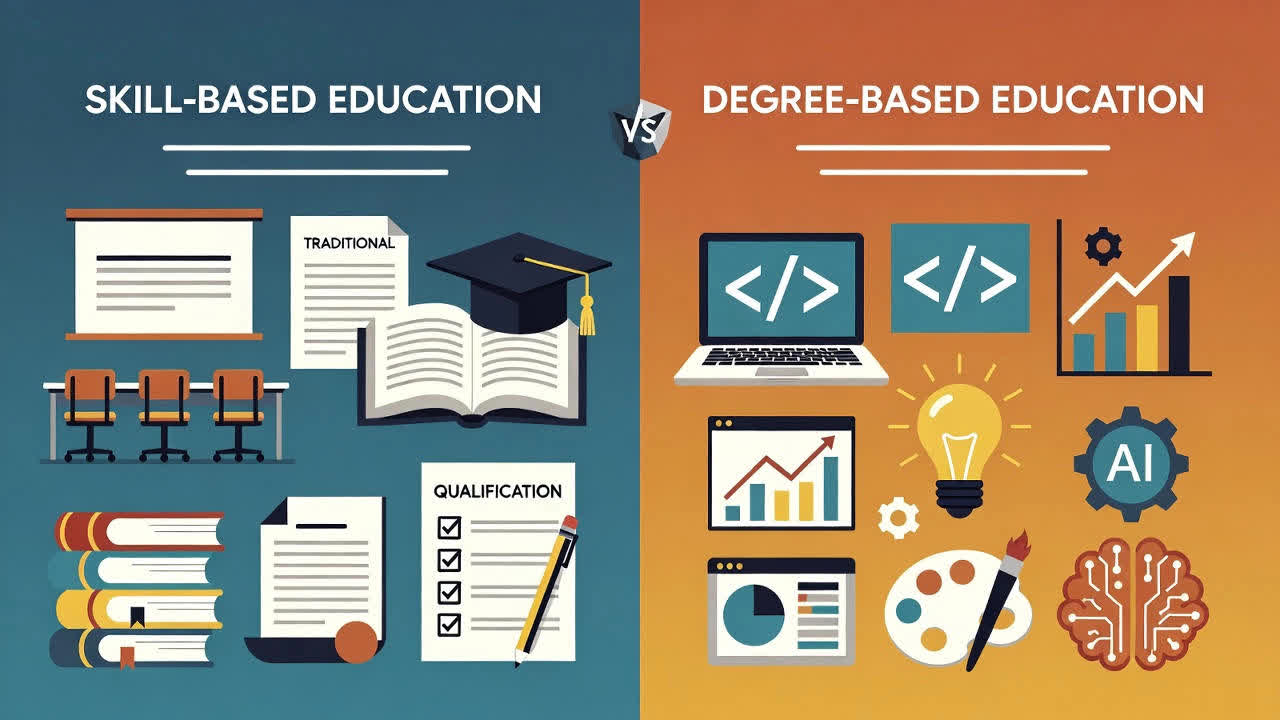
In today’s fast-changing job market, one question is becoming more common among students and parents: skill based education vs degree – which is better? Earlier, a college degree was considered the only path to success. But now, companies are focusing more on practical skills than certificates. This shift has changed how people think about education, jobs, and long-term career growth.
In this article, we will clearly explain why skill based education is better than degree in many cases, using real-world examples, job trends, salary potential, and future opportunities — in simple, easy-to-read language.
What Is Skill Based Education?
Skill based education focuses on learning practical, job-ready skills rather than only theoretical knowledge. The goal is to make a person employable by teaching what companies actually need.
Examples of Skill Based Education
- Digital marketing
- Web development
- Graphic designing
- Data analysis
- AI tools & automation
- Video editing
- Cybersecurity
- Sales and communication skills
These skills can be learned through online courses, bootcamps, internships, and hands-on projects.
Also Read: Online MBA Programs – Build Your Career with Flexible and Affordable Business Education
What Is Degree-Based Education?
Degree-based education is the traditional academic system, where students spend 3–5 years in colleges or universities to earn certificates like BA, BSc, BCom, BTech, or MBA.
Features of Degree Education
- Focus on theory and exams
- Fixed curriculum
- Longer time duration
- High cost (fees + living expenses)
- Less practical exposure in many cases
A degree is still valuable, but it does not guarantee a job anymore.
Skill Based Education vs Degree: Core Difference
| Factor | Skill Based Education | Degree Education |
|---|---|---|
| Focus | Practical skills | Theory + syllabus |
| Time | Short (3–12 months) | Long (3–5 years) |
| Cost | Affordable | Expensive |
| Job Readiness | High | Often low |
| Career Flexibility | Very high | Limited |
| Industry Demand | Strong | Declining in many fields |
Why Skill Based Education Is Better Than Degree
1. Companies Prefer Skills Over Degree
Today, many companies openly say that skills matter more than degrees. Tech giants, startups, and even MNCs test candidates on:
- Problem solving
- Practical knowledge
- Portfolio & projects
- Real work experience
That’s why people often search:
degree or skill which is better for job
The answer in most modern industries is skills.
2. Faster Entry into Job Market
Skill based courses allow students to start earning faster. Instead of waiting 3–4 years:
- You can learn a skill in 6 months
- Build a portfolio
- Apply for jobs or freelance work
This is why skill based courses after 12th are becoming very popular.
3. Higher Salary Potential in Less Time
Many skill-based roles offer high salary packages without a formal degree.
High-Paying Skill Based Jobs:
- Digital marketer
- Web developer
- UI/UX designer
- Data analyst
- SEO specialist
- AI prompt engineer
This answers another common query:
skill based courses with high salary
4. Skills Are Future-Proof
Degrees can become outdated, but skills can be upgraded anytime. New technologies emerge every year, and skill-based learners adapt faster.
That’s why many people ask:
future jobs need skills or degree
The future clearly belongs to continuous skill learning.
5. Better for Freelancing & Online Income
Degrees are not required for:
- Freelancing
- Remote jobs
- Online businesses
- Content creation
- Affiliate marketing
Skill based education opens doors to multiple income streams, making it ideal for students and working professionals.
Limitations of Degree-Based Education
This doesn’t mean degrees are useless, but they have limitations:
- Outdated syllabus
- Lack of practical exposure
- High unemployment among degree holders
- Dependence on campus placements
- No guarantee of job security
This is why degree vs skill based education salary comparisons often favor skilled professionals.
When Degree Is Still Important
To be balanced, degrees are still important in certain fields:
- Medical
- Law
- Government jobs
- Academic research
But even in these fields, skills + degree together work best.
Skill Based Education Benefits for Students
Key Advantages:
- Learn what industry needs
- Start earning early
- Lower education debt
- Flexible career paths
- Global job opportunities
- Strong confidence & independence
This makes skill-based learning especially useful for:
- Students from middle-class backgrounds
- Career switchers
- Freelancers
- Entrepreneurs
Degree or Skill: Which Is Better for You?
Ask yourself these questions:
- Do you want a job quickly?
- Are you interested in real-world work?
- Do you want flexible income options?
- Are you ready to keep learning continuously?
If yes, skill based education is a smarter choice.
Best Strategy: Combine Degree + Skills
The smartest approach is not choosing one, but combining both:
- Degree for foundation
- Skills for income and growth
This combination makes you highly employable and future-ready.
Also Read : Student Visa for USA – Step-by-Step Guide to Study in America
Conclusion
So, when we honestly compare skill based education vs degree, it becomes clear that skills play a bigger role in modern careers. Degrees alone are no longer enough. The world now values what you can do, not just what certificate you hold.
If your goal is job security, income growth, and career freedom, skill based education is not just better — it is essential.
Frequently Asked Questions – Skill Based Education vs Degree
Q1. Is skill based education better than a traditional degree?
Skill based education is often better for job readiness because it focuses on practical skills that employers actually look for, while degrees mostly emphasize theoretical knowledge.
Q2. Can you get a job without a college degree?
Yes, many companies hire candidates without degrees if they have strong, relevant skills, real-world experience, and a solid portfolio.
Q3. Which option helps you start earning faster: skills or degree?
Skill based learning usually helps people start earning faster because most skill courses take only a few months, unlike degrees that require several years.
Q4. Do skill based jobs pay well?
Yes, skill based roles in fields like technology, digital marketing, data analysis, and design often offer high salaries, sometimes even higher than degree-based jobs.
Q5. Are degrees becoming less important in the job market?
Degrees are still valuable in certain professions, but in many industries, employers now prioritize skills, experience, and problem-solving ability over formal education.
