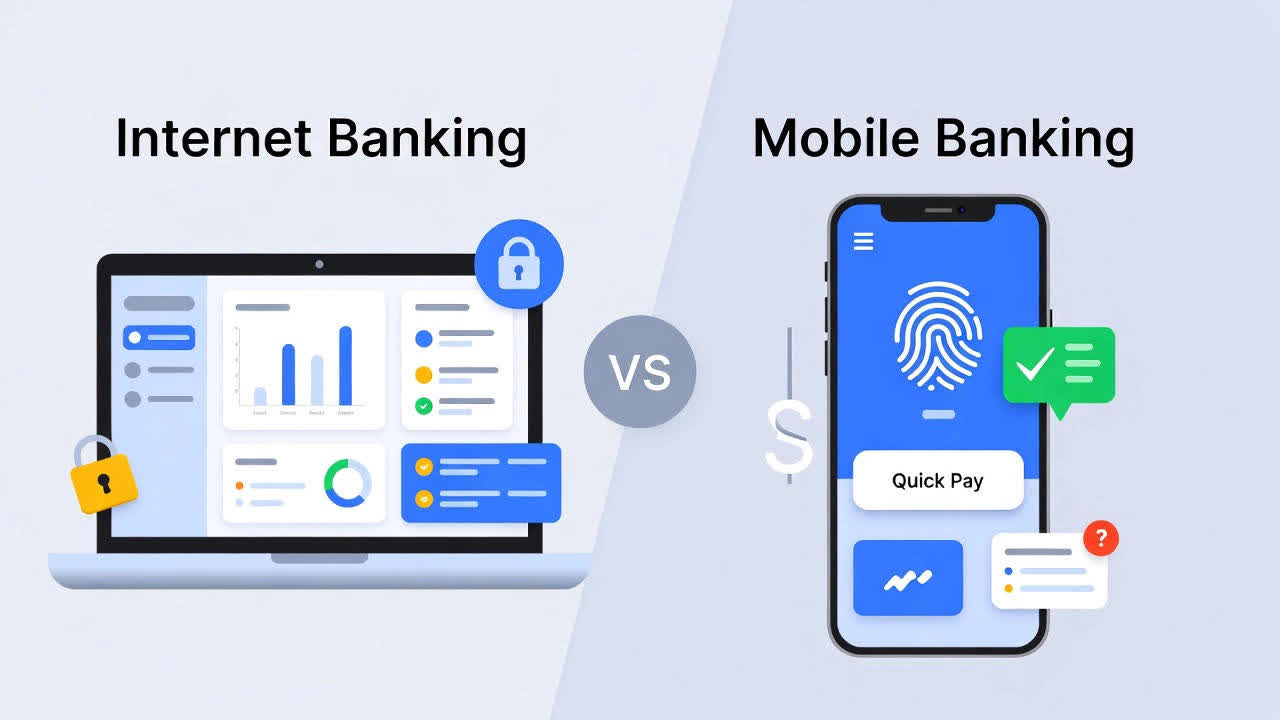
When comparing internet banking vs mobile banking, many people wonder which option is more convenient, secure, and suitable for daily financial needs. Both internet banking and mobile banking allow users to manage their bank accounts digitally, but they work in slightly different ways and are designed for different usage habits.
In this detailed guide, we’ll break down the differences between internet banking and mobile banking, explain how each works, discuss benefits and limitations, and help you decide which one is better for you.
What Is Internet Banking?
Internet banking, also known as online banking, allows users to access their bank accounts through a web browser on a computer or laptop. You log in using your bank’s official website and perform financial transactions online.
Common Internet Banking Services
- Check account balance and statements
- Transfer funds (NEFT, RTGS, IMPS)
- Pay utility bills
- Download bank statements
- Apply for loans or cards
- Manage fixed deposits
Internet banking is widely used for detailed and large financial activities.
Also Read: Credit Card and Personal Loan Difference: Complete Guide
What Is Mobile Banking?
Mobile banking is a service provided through a bank’s mobile app installed on a smartphone or tablet. It offers quick access to banking features anytime and anywhere.
Common Mobile Banking Services
- Check balance instantly
- Quick fund transfers
- Scan and pay (UPI, QR code)
- Bill payments and recharges
- Card management
- Transaction alerts
Mobile banking is designed for speed and convenience on the go.
Internet Banking vs Mobile Banking: Key Differences
Let’s understand the difference clearly with a feature-by-feature comparison.
1. Device Requirement
Internet Banking
- Requires a desktop or laptop
- Works through a web browser
Mobile Banking
- Requires a smartphone
- Works through a dedicated app
2. Ease of Use
Internet Banking
- Better for detailed tasks
- Larger screen helps with forms and statements
Mobile Banking
- Very easy and quick
- Designed for fast transactions
3. Accessibility
Internet Banking
- Needs stable internet and browser
- Not ideal for quick access
Mobile Banking
- Accessible anywhere
- Ideal for instant transactions
4. Speed of Transactions
Internet Banking
- Slightly slower due to login and navigation
Mobile Banking
- Faster with biometric login and quick actions
5. Security Features
Internet Banking
- Passwords
- OTP authentication
- Secure browser encryption
Mobile Banking
- App-level encryption
- PIN, fingerprint, or face recognition
- OTP for transactions
Both are secure when used responsibly.
Advantages of Internet Banking
Internet banking offers several benefits, especially for users who prefer detailed financial management.
Key Benefits
- Ideal for complex transactions
- Easy access to detailed account statements
- Better for managing multiple accounts
- Convenient for business users
- Full control over banking services
Internet banking works best when accuracy and detailed information are required.
Advantages of Mobile Banking
Mobile banking focuses on speed and convenience.
Key Benefits
- Instant access anytime
- Quick fund transfers
- Easy bill payments
- User-friendly interface
- Push notifications for transactions
Mobile banking is perfect for daily and frequent usage.
Limitations of Internet Banking
Despite its benefits, internet banking has some drawbacks.
Disadvantages
- Requires a computer or laptop
- Not ideal for quick transactions
- Less convenient while traveling
- Slower login process
Limitations of Mobile Banking
Mobile banking also has a few limitations.
Disadvantages
- Smaller screen size
- Not suitable for complex tasks
- App compatibility issues on older phones
- Dependent on smartphone performance
Internet Banking vs Mobile Banking: Which Is More Secure?
Security is a major concern when comparing internet banking vs mobile banking.
Internet Banking Security
- Strong encryption
- OTP verification
- Secure login via official website
Mobile Banking Security
- Encrypted apps
- Biometric authentication
- Device-level security
👉 Both are safe, but mobile banking offers extra convenience through biometric login.
Which One Is Better for Different Users?
The choice depends on how you use banking services.
Best for Students
- Mobile banking
- Easy recharges and UPI payments
Best for Working Professionals
- Both internet and mobile banking
- Mobile for daily use, internet for detailed tasks
Best for Business Owners
- Internet banking
- Better for bulk payments and account management
Best for Senior Citizens
- Internet banking (larger screen)
- Easier to read and manage
Internet Banking vs Mobile Banking: Feature Comparison Table
| Feature | Internet Banking | Mobile Banking |
|---|---|---|
| Device | Computer/Laptop | Smartphone |
| Accessibility | Moderate | High |
| Speed | Moderate | Fast |
| Ease of Use | Detailed | Very Easy |
| Security | High | Very High |
| Best For | Complex tasks | Daily transactions |
Can You Use Both Internet and Mobile Banking Together?
Yes, and that’s actually the best approach.
How to Use Both Smartly
- Use mobile banking for daily payments
- Use internet banking for statements, applications, and bulk transactions
Using both gives you flexibility and full control.
Tips to Use Digital Banking Safely
Whether you use internet banking or mobile banking, follow these safety tips:
- Never share OTP or passwords
- Use strong login credentials
- Avoid public Wi-Fi for banking
- Install apps only from official app stores
- Log out after using internet banking
Security depends on user awareness as much as technology.
Common Mistakes Users Make
Avoid these mistakes while using digital banking:
- Saving passwords in browsers
- Clicking on unknown links
- Using fake banking apps
- Ignoring transaction alerts
Being careful prevents financial loss.
Future of Digital Banking
Both internet banking and mobile banking will continue to evolve. However, mobile banking is growing faster due to smartphone usage, while internet banking remains essential for advanced features.
Banks are focusing on:
- Better app experiences
- Faster transactions
- Stronger security
- User-friendly interfaces
Also Read: Zero Balance Saving Account Benefit Explained: Complete Guide for Easy and Smart Banking
Conclusion
The debate of internet banking vs mobile banking doesn’t have a single winner. Both serve different purposes. Internet banking is ideal for detailed and complex financial tasks, while mobile banking is perfect for quick, everyday transactions. Instead of choosing one, using both together gives the best digital banking experience.
Your lifestyle, device preference, and banking needs should decide which one you use more.
